What is MCP? Model Context Protocol explained for finance teams
It’s Monday morning and your CEO wants to know why the margin dropped last quarter. You open your AI tool, paste in a spreadsheet export and hope it reads the columns right. It writes a confident answer. Then you spend half an hour checking whether the numbers are real. On their own, AI tools don’t know your numbers. They only know what you paste in, and they fill the gaps with guesses.
Model Context Protocol (MCP) fixes that. Here’s what it is, how it works and what it means for finance teams, including how our Plug and play MCP brings it to your BrightAnalytics data.
Reading time: 3 min.

What is MCP?
Model Context Protocol (MCP) is an open standard that lets AI tools connect to other software and use its data. In practice, your AI tool looks up the real answer instead of guessing.
Think of it as a universal plug. Before MCP, every AI tool needed its own custom connection to every app. With MCP, a piece of software builds one connection, and any AI tool that supports the standard can use it. Claude, ChatGPT and Copilot all work with MCP.
How does MCP work?
An MCP connection has three parts:
- The AI tool you already use, like Claude, ChatGPT or Copilot.
- The MCP server, a small piece of software that sits in front of an app or platform and tells the AI tool what it can look up there, like our Plug and play MCP.
- The app and its data, like BrightAnalytics.
When you ask a question, your AI tool picks the right MCP server, asks it for the data and answers based on what comes back. No exports or copy-pasting needed.
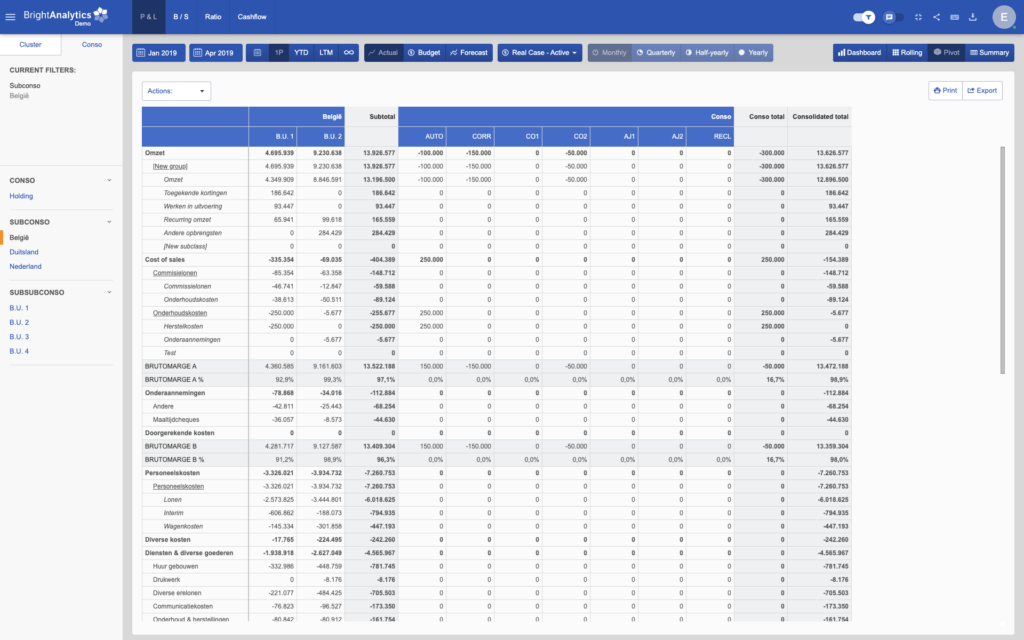
With our Plug and play MCP, you can ask Claude “How are we tracking against budget this year?” and get the same numbers you’d see in BrightAnalytics.
Why MCP matters for finance teams
Finance teams get a steady stream of ad hoc questions. What drove the cost increase in Norway? How are we tracking against budget? Which customers grew this year? Each one usually means an export, a pivot table and a few rounds of checking.
MCP shortens that loop. You ask in plain language, get an answer in seconds and ask follow-up questions in the same conversation. Your AI tool can also build tables or draft a first management summary from your actual numbers in BrightAnalytics.
Take the question about Norway. With our Plug and play MCP, your AI tool pulls the costs for your Norwegian entities straight from BrightAnalytics, already translated into your group currency and with intercompany costs left out, and compares them with last year. If the answer raises a new question, like which suppliers drove the increase, you just ask that next.
Not every connection gives the same answers
MCP is a way to connect. It doesn’t make the data behind the connection any better. And in finance, that’s what decides whether you can trust the answer.
AI tools can connect to almost anything, including a data lake or an enterprise resource planning (ERP) system directly. But raw data leaves the AI to work out the structure on its own. Which accounts belong together? Which entities need eliminating? Which currency applies? That’s where it can miss things, or worse, make numbers up.
That’s why we built our Plug and play MCP on top of the core BrightAnalytics engine. Every general ledger (GL) account from your ERP systems, legacy systems and finance apps is already mapped into one structure. Currency translations, intercompany eliminations and custom allocations are already done.
It also knows your business context, so there’s no prompt engineering needed. That might sound like a small thing, but it saves a lot of work.
What is prompt engineering?
Prompt engineering means writing detailed instructions so an AI tool understands your data before it can answer. With a raw data connection, that might look like this: “Accounts 8000 to 8999 are revenue. Our fiscal year starts in April. Leave out intercompany sales. Entity UK01 reports in pounds, so convert it to euros at the average rate.”
Someone then has to keep those instructions up to date. Miss one detail and the answer is off, often without anyone noticing. With our Plug and play MCP, you skip all of that. It already knows your mappings, periods and group structure.
Is MCP secure?
First, permissions. A good MCP server follows the user permissions you already have in the platform. Our Plug and play MCP does exactly that. If you can’t see payroll records or a certain entity in BrightAnalytics, your AI tool can’t see them either, whichever tool you use.
Second, your AI license. Pair MCP with your organization’s enterprise large language model (LLM) license, and your data stays confidential and is never used to train someone else’s model.
MCP at BrightAnalytics
Our Plug and play MCP connects Claude, ChatGPT or Copilot to your BrightAnalytics data in a few clicks. It works alongside the AI features already built into BrightAnalytics. Use those for instant answers inside the platform, and the MCP to bring the same validated numbers into your own AI tools.
Once it’s connected, you can ask ad hoc questions by entity, cost center, customer or supplier, and let your AI tool draft a first board report from your actual numbers. You can also put your financials next to data from other systems you connect, like your customer relationship management (CRM) system, or let your own scripts and agents run checks on a schedule.
Learn more
- Request more information
Leave your details and we’ll be in touch with more information about our MCP.